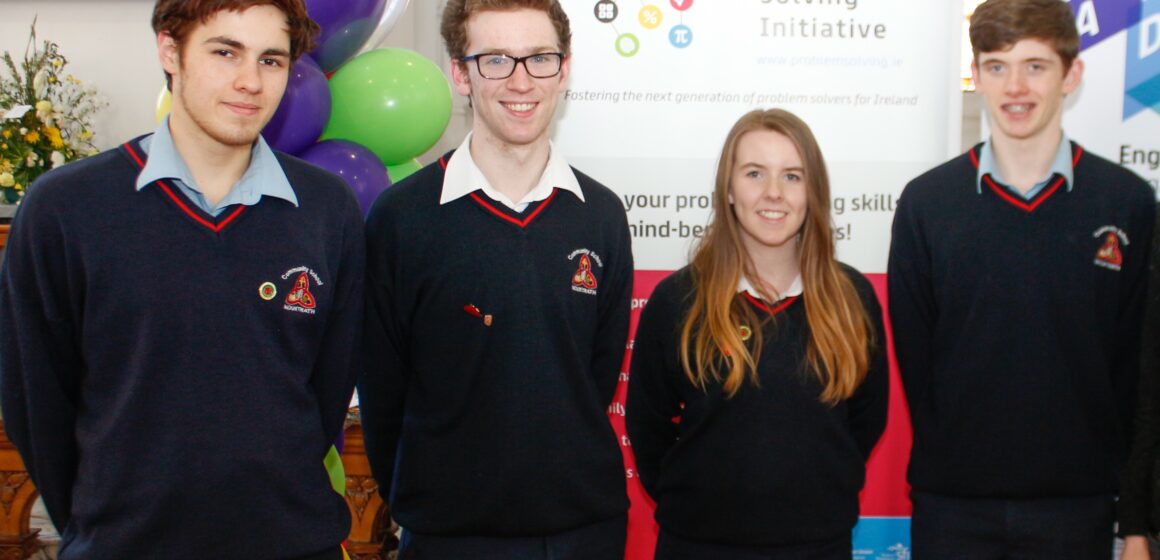
Four secondary school students from Mountrath Community School have been announced as winners of the team competition at the All Ireland Linguistics Olympiad (AILO) final in Dublin. The team consisted of Alex Moore, Domhnall O’Farrell, Aisling Page and Christopher Carew.
The Mountrath students beat off competition from 42 other schools around Ireland to take the team trophy. The AILO competition has been run by the ADAPT Centre for Digital Content Technology since 2009 and challenges students to use their ingenuity, creativity and skill to decipher languages with examples of translations.
The AILO final saw the top 100 students out of a starting line up of over 4,000 opponents compete. Competitors are challenged to engage in ‘code-breaking’ tests to unlock information in unfamiliar languages. No prior knowledge of a second language is needed with competitors required to use logical reasoning and out-of-the-box thinking to solve the problems presented.
Speaking about the competition, Professor Vincent Wade, Director of the ADAPT Centre said: “The All Ireland Linguistics Olympiad puzzles are a mix of maths, science and humanities. The increasing popularity of the competition highlights the Irish public’s interest and appreciation for the imporance and applicability of problem-solving skills across science, the economy and society. We are looking forward to hosting and running a free, family-friendly problem-solving festival in Dublin Castle on 5th August which is open to all.”
Run by the Science Foundation Ireland funded ADAPT Centre, AILO aims to inspire the next generation of multilingual technology graduates, who possess a combination of language competency and problem-solving expertise. Participants in AILO 2017 received tuition from experts at the ADAPT Centre to assist them in how to approach the puzzles.
The AILO 2019 Final will take place in Dublin City University, Glasnevin, Dublin on Tuesday 26th March 2019. This round will take the top 100 students from the schools preliminary round on Tuesday 29th January 2019.
The final will start at 09.30 in “The Venue” in the U Student Centre and the team competition will take place that afternoon.
For details on how to get to Dublin City University please see here.
The preparations for the All Ireland Linguistics Olympiad 2017 (AILO) picked up the pace in January this year with 17 problem-solving workshops held in schools and universities across the country reaching almost 480 students from across the island of Ireland. AILO is a key element of the nationwide Problem-Solving Initiative, supported by Science Foundation Ireland and run by the ADAPT Centre.
These workshops gave students a valuable opportunity to work through linguistics problems with experts from ADAPT and previous AILO competitors by practising their problem solving strategies and linguistics skills.
This year we teamed up with Queen’s University Belfast and the University of Limerick to host workshops for students in the area. Workshops were also held in Cork City, Tralee, Athlone, Athenry, Castlebar, Letterkenny, Dublin, Wicklow and Maynooth among others.
Almost 4,000 students will compete in the first round of AILO 2017 in their schools on 1st February 2017. The top 100 language decoders will qualify for the national final of AILO 2017 on 24th March at Dublin Institute of Technology.
The All Ireland Linguistics Olympiad (AILO) is a competition for post-primary pupils to test their ability to solve complex problems in languages from around the world. No prior knowledge of the language is required and the competition is a test of logic, patience and the ability to think outside the box!
The Olympiad is open to participants in Northern Ireland and the Republic of Ireland. Students can enter one of two categories: Junior (up to 16 years of age) and Senior (over 16 years of age).
Queen’s University Belfast will host workshops on 13th January 2017 to help students hone their problem-solving strategies ahead of competing in the qualifying round of AILO 2017 in February. ADAPT tutors will guide students through sample puzzles during a 2-hour workshop.
Spaces in the workshops are limited and will be offered on a first-come, first-served basis.
The Problem-Solving Initiative will foster the next generation of problem solvers for Ireland
Search is on for Ireland’s top young problem solver
On 7th November 2017 Minister for Jobs, Enterprise and Innovation, Mary Mitchell O’Connor, TD, launched a major nationwide initiative aimed at fostering the next generation of skilled problem solvers for Ireland. The Problem-Solving Initiative (PSI) will encourage Irish youngsters to hone their lateral-thinking skills, and will create enthusiasm within the Irish public for problem-solving by engaging people directly with mind-bending puzzles and challenges. It will also promote career pathways in Science, Technology, Engineering and Mathematics (STEM) for those who enjoy solving problems. The two-year initiative is delivered by the ADAPT Centre for Digital Content Technology, led out of Trinity College Dublin, and funded by Science Foundation Ireland (SFI).
Speaking about the initiative, ADAPT Director Professor Vincent Wade said: “Creative problem-solving and lateral thinking is at the heart of STEM. The PSI will empower the youth of Ireland to hone these transferable skills, which are a critical requirement for the future leaders in STEM fields. It will also raise public awareness of the importance of problem-solving skills across science, the economy and society.”
The programme of events will include expansion of the ADAPT Centre’s highly-successful All Ireland Linguistics Olympiad (AILO). AILO challenges secondary school students to develop their own problem-solving strategies to decode the world’s toughest puzzles in language, logic and linguistics. The contest, which has attracted 14,000 participants to date, aims to discover Ireland’s top young problem solver. Schools can register now at www.adaptcentre.ie/ailo
Welcoming the Problem Solving Initiative, Minister for Jobs, Enterprise and Innovation, Mary Mitchell O’Connor, TD, said: “I would like to congratulate Team Ireland on their recent success at the 2016 International Linguistics Olympiad, and would encourage all schools to take part in this wonderful Problem Solving Initiative run by the ADAPT Research Centre. I am keen to raise people’s awareness of the importance of problem solving skills across science, the economy and society as a whole and I would also like to invite people of all ages to try out the various brain teasers to hone their problem solving skills; skills that are at the very heart of Science, Technology, Engineering and Maths advancement in our world.”
Minster of State for Training, Skills and Innovation, John Halligan said: “The Problem Solving Initiative builds on the success of ADAPT’s AILO Competition which encourages secondary school students to perfect their analytical skills. Problem solving skills are crucial not only for STEM related careers but across society. The Problem Solving Initiative provides the opportunity to develop analytical skills in a fun engaging way. I strongly encourage everyone to put their skills to the test and challenge your friends and colleagues to try the brain teasers.”
Other key elements of the Problem-Solving Initiative include:
Problem-solving workshops at public festival events during Science Week, 13th to 20th November 2016.
The International Linguistics Olympiad 2017, which will see the top 180 problem solvers from more than 30 countries compete at Dublin City University from 31st July to 4th August 2017.
Mind-bending puzzles available to the public through www.problemsolving.ie and via social media.
The impact of the initiative is already reflected in the strong performance of Team Ireland at the International Linguistics Olympiad 2016 in Mysore, India in July 2016. Claire O’Connor (17) from St. Louis High School, Rathmines beat 180 contestants from 30 countries to secure a bronze medal. Dónal Farren (17) of St Eunan’s College, Letterkenny and Pádraig Sheehy (16) of Gonzaga College, Ranelagh won Honourable Mention awards.
Speaking about her experience student Claire O’Connor said: “Since taking part in AILO and IOL I’ve learned that keeping an open mind and trusting your instincts prevents you from ruling out valuable ideas that may seem implausible at first. I now know not to always keep my focus linear when faced with problems“.
Secondary school students are encouraged to sign up for the All Ireland Linguistics Olympiad 2017 now at www.adaptcentre.ie/ailo
View the Photo Gallery from the Launch:
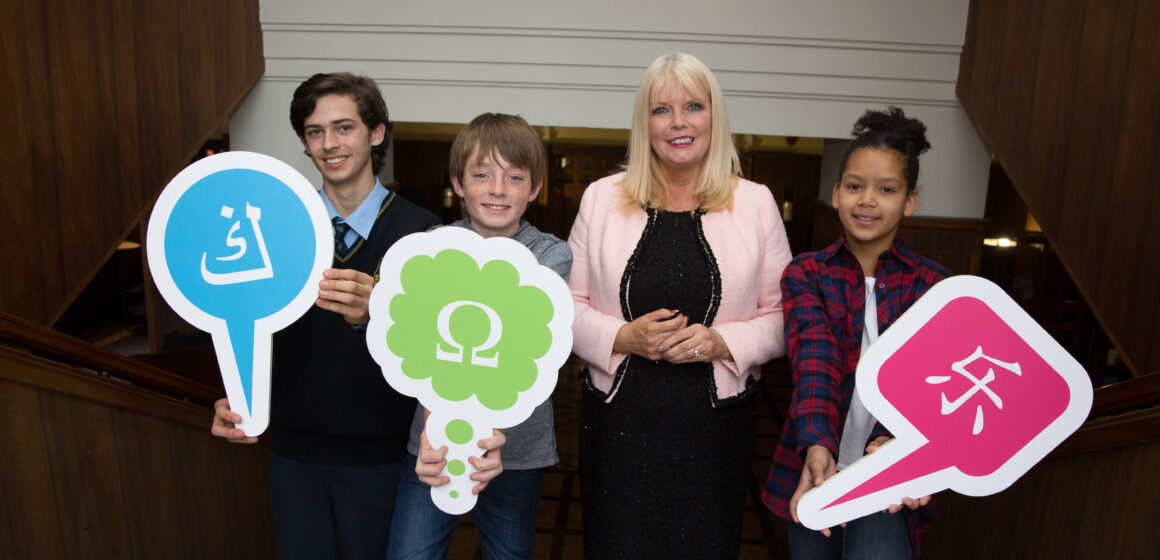
Pictured with Minister Mitchell O’Connor at the launch of the initiative at Government Buildings are Alex Harding of Maynooth Post-Primary, and Finn Corcoran and Juliette Kodia of Rush and Lusk Educate Together National School.
Pictured at the launch of the national Problem-Solving Initiative (www.problemsolving.ie) at Government Buildings are Alex Harding of Maynooth Post-Primary, and Finn Corcoran and Juliette Kodia of Rush and Lusk Educate Together National School.
Pictured at the launch of the national Problem-Solving Initiative (www.problemsolving.ie) at Government Buildings are Alex Harding of Maynooth Post-Primary, and Finn Corcoran and Juliette Kodia of Rush and Lusk Educate Together National School.
Pictured with Minister Mitchell O’Connor at the launch of the initiative at Government Buildings is Claire O’Connor (18) from Portobello, Dublin, who won a bronze medal for Ireland at the the International Linguistics Olympiad language decoding contest in Mysore, India in July 2016.
Pictured with Minister Mitchell O’Connor at the launch of the initiative at Government Buildings are Alex Harding of Maynooth Post-Primary, and Finn Corcoran and Juliette Kodia of Rush and Lusk Educate Together National School.
Pictured at the launch of the national Problem-Solving Initiative (www.problemsolving.ie) at Government Buildings are Alex Harding of Maynooth Post-Primary, and Finn Corcoran and Juliette Kodia of Rush and Lusk Educate Together National School.
Find out more by viewing the Problem-Solving Initiative Video:
The ADAPT Centre is seeking partners and sponsors for the Problem-Solving Initiative (PSI) to help ensure the wide reach and deep impact of this ambitious initiative.